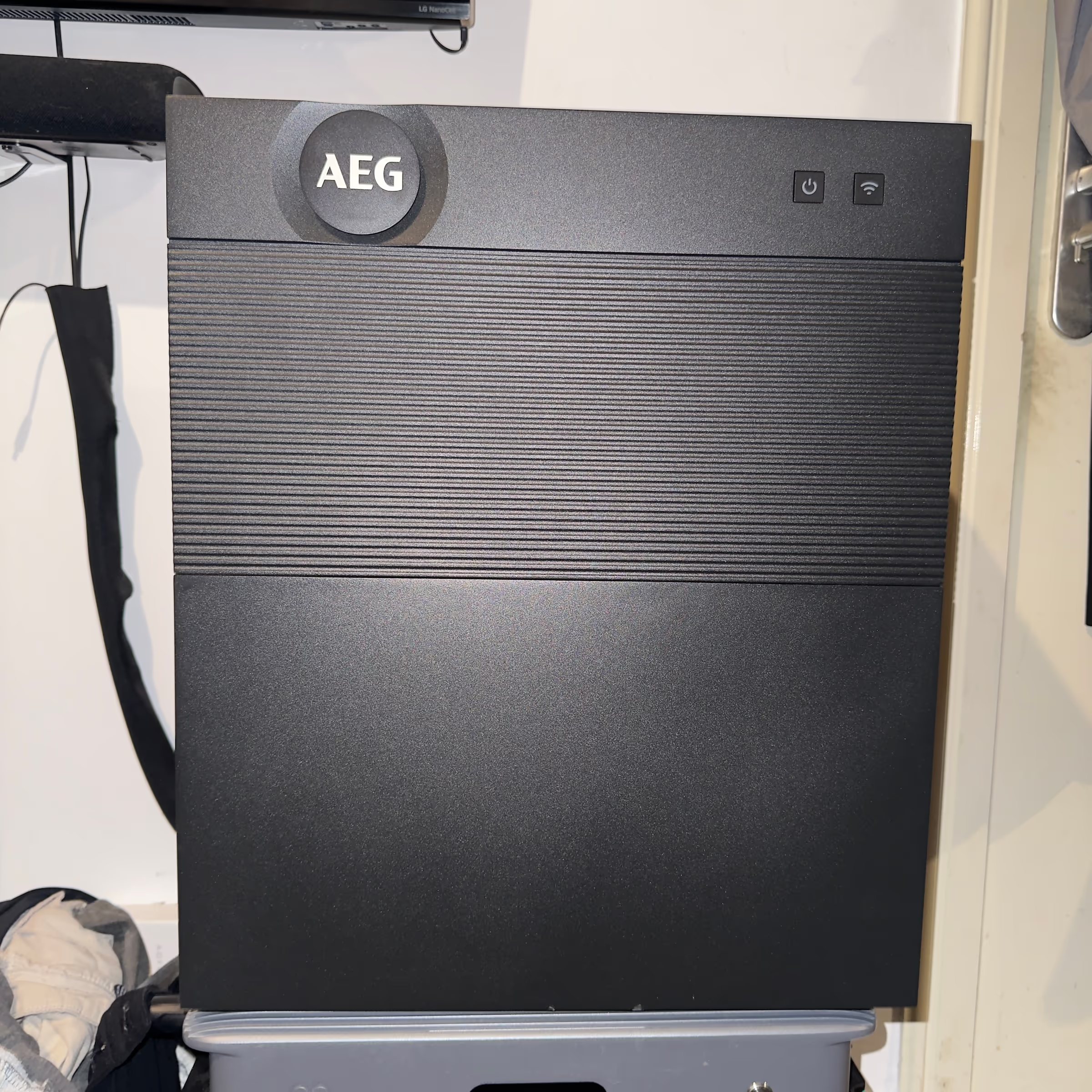
AEG
AEG SolarCube Pro tested: what comes out of this unit, and where the rest goes
Getest door Jay, 11 and 12 September 2026
round trip, over a closed charge and discharge cycle
81.29%
eigen metingour techbench, 800 W setting, 12 September 2026
Usable
5.89 kWh
eigen metingDC side, 3000 W setting, 12 September 2026
Round trip
81.29%
eigen metingclosed cycle, 800 W setting, 12 September 2026
Grid power
800 or 3000 W
eigen metingtwo settings in the app, nothing in between, 12 September 2026
Own consumption
41 to 47 W
eigen metinggrid and battery side together, 3000 W setting, 12 September 2026
Wat werkt
- The closed loop is measured, not derived, and two routes land on the same decimals
- The loss fits one formula, and that formula predicts the steps that were measured afterwards
- Regulates against a HomeWizard P1 you already have in your meter box
- Control is local: RS485 to Modbus TCP, no cloud in the path
- The device guards the stop state of charge itself, even if your script dies
- After a deep discharge it came back by itself, with both packs, without intervention
- A brand with a registration in the Netherlands and a service address that names the model number
Waar je op moet letten
- Grid power is a switch: 800 W or 3000 W, nothing in between
- You do not choose the charge power in the app; only over Modbus, with register 4113
- Below about 41 W requested, it is a net importer
- There is no real off: even with the button off it draws 9.3 W, and off the grid it drains itself
- Modbus without a matching register document, without a watchdog and without a working third-party EMS mode
- The firmware would not update, and the service address gave no answer in thirteen days
- The datasheet puts it at 800 W, the app at 3000 W
- Ten years of warranty without a text that covers this model
Dit artikel is opgebouwd uit onze eigen meetkaart. Elk getal draagt zijn herkomst en de netstand waarop het gemeten is.Zo is er gemeten
AEG
Solarcube Pro
€ 1.799derde partijpeildatum 12 september 2026
Alle specificaties met herkomstInhoudsopgave
- 1Key takeaways
- 2How it was measured
- 3What it is
- 4What comes out
- 5What you can set yourself
- 6Control and integrations
- 7The registers, for anyone who wants to control it themselves
- 8Heat, noise and build
- 9After the test: off the grid, it drained itself
- 10The specifications, with origin
- 11Where the sources contradict each other
- 12What I don't know yet
- 13Closing
- 14Alternatives
- 15Frequently asked questions
- 16Related articles
- 17Transparency
- 18Sources
Jay's Desk
Choose the wrong plug-in battery and you do not lose money once, you lose a little every day: in power that never comes back out, in a setting that quietly imports, in an app that can do less than the hardware underneath. This one costs € 1,799. third partyVoltsmile, multi-solar.nl and aegthuisbatterij.nl, lowest asking price for the AS-BBL08-6K, rechecked on 1 October 2026 · 1 October 2026
It does what a home battery has to do. But there is a brand underneath that is not on the box, a port that is not in the specification table, and after the test it did something no datasheet mentions: off the grid it drained itself, until the battery management system locked it out. It came out of that by itself, but only 4 days and 5 hours after it was back on the grid. own measurementModbus readout and the app, cell voltage logged per minute · not recorded; off the grid, then locked out · 30 September 2026
It spent two days on our own measurement setup. The whole discharge curve was walked by hand from 2850 W back down to 30 W, the port on the back was opened up, and on the second evening the cycle was closed: first empty, then full, and the difference counted. own measurementour techbench, metering plug and DC side · 3000 W and 800 W setting · 12 September 2026
What the bench produced is figures, each with who says it, and each measurement with the setting it was taken at. I do not give it a grade. After that, you decide.
Key takeaways
- Of every 100 kWh you put in, 81 come back; at a reference price of 25 cents per kWh, you leave € 4.68 behind. 1,165 Wh went in and 947 Wh came out: 81.29% round-trip efficiency over a closed cycle. Two independent routes, the kWh counters of the metering plug and 1879 samples of DC power, land on the same two decimals. My own earlier calculation said 84.3%, and it was wrong: 2.67% of the DC energy does not come back out of the battery itself, and that figure is on no product sheet. own measurementour techbench, closed charge and discharge cycle · 800 W setting · 12 September 2026 derivedfrom 81.29% and the reference price of € 0.25 per kWh
- Usable: 5.89 kWh on the DC side. One datasheet promises 6.0 kWh, the other calculates with 90% depth of discharge and arrives at 5.43 kWh. We land in between. own measurementour techbench, DC side, 2850 W charge leg · 3000 W setting · 12 September 2026
- Grid power is a switch with two settings: 800 W or 3000 W. Nothing in between. At the 760 W ceiling it charges at 90.61%. own measurementour techbench, metering plug · 800 W setting · 12 September 2026 You do not choose the charge power in the app, but you can over Modbus: register
4113limits forced charging from about 190 W up to the ceiling of the grid setting. own measurementour techbench, metering plug, Modbus writes to 4113 · 800 W setting · 1 October 2026 - Below about 41 W requested, it is a net importer. The schedule that was in the app on arrival, 15 / 30 / 45 W, has all three steps at or below that tipping point. own measurementour techbench, metering plug and DC side · 3000 W setting · 12 September 2026
- Control is local, over one wire. It regulates against a HomeWizard P1 you already have in your meter box, and the RS485 port speaks Modbus without a cloud in the path. That port is in the manufacturer's drawing and not in its specification table, and a register document that matches this device does not exist. That is why our own register map is below. own measurementModbus readout over RS485, RJ45 pins 7 and 8, unit 1 · n/a · 12 September 2026
- There is no real off. Even with the button off it still draws 9.3 W. Off the grid that consumption comes from the battery, and then it drains until the battery management system locks it out. own measurementmetering plug and Modbus readout, after the recovery · n/a, button off · 30 September 2026
- The firmware would not update, the service address gave no answer in thirteen days, and the only warranty document I can find covers a different model. That is written out below, with the two product sheets that contradict each other.
ℹ️Info
The device and its specifications are in the catalogue: AEG Solarcube Pro (in Dutch). Every figure there carries the same origin as here.
How it was measured
- Unit: 34302261602711
- Firmware: 331 / 259 / 286 / 259
- Test date: 2026-09-11 to 2026-09-12
- Test duration: two bench days; a discharge ladder from 2850 W back down to 30 W on the first day, and on the second evening a closed cycle: discharging from 18:22 to 19:53 at 710 W, charging from 20:04 to 21:29 at the 760 W ceiling. After that, from 15 to 30 September, off the bench: the unit off the grid, the lockout and the recovery, followed over Modbus and in the app
- Grid setting: the ladder on the 3000 W setting, the closed cycle on the 800 W setting; the setting is given with every figure in this piece. For what happened after the test, the grid setting was not recorded
- Instrument: our techbench, with the kWh counters of the metering plug on the grid side and the integrated DC power from the device's own registers on the battery side; on the ladder, a second meter in series as a check; the model string, the firmware and the registers were read from the device itself, over RS485
- Measurement log: aeg-solarcube-2026-09-11
One unit is one unit. Everything below is about this device on this firmware in these weeks, not about the model range and not about the brand. And the setup has a limit: at about 13 A the metering plug runs into the 45 K limit of IEC 60884, so above 2.3 kW the measurements were short and attended, not hours long. own measurementour techbench, metering plug · 3000 W setting · 12 September 2026
What it is
A plug-in battery of almost 6 kWh with a 3 kW inverter inside, which plugs into a wall socket and regulates against a P1 meter: charging on the surplus from the panels during the day, delivering back to the house in the evening. Two LFP packs, an inverter unit on top, and an app. The tested set is the stack with an expansion battery underneath. The datasheet gives 6.028 kWh nominal, 3 kW charging and discharging as one combined figure, and 3 kVA apparent power on a separate off-grid port. manufacturerDutch product sheet AS-BBL08 via APEX, and sheet V2.0 · 19 August 2026
The brand needs more explanation than the device. AEG is a brand name used under licence from AB Electrolux (publ); that is stated word for word in the footer of the datasheet. The datasheet itself is from Solar Solutions Group. The manual carries an address in Switzerland: SOLAR SOLUTIONS AG, Riedweg 3, 6418 Rothenthurm. The only published warranty terms are in the name of Solar Solutions Products B.V. in Hazerswoude. And the builder is HYXi: the bench read a register layout of the HYXI HALO, with its own deviations. That is a lot of names for one box. manufacturersheet V2.0 footer, manual, general-limited-warranty-high-voltage-batteries.pdf · 12 September 2026 own measurementModbus readout, register layout · n/a · 12 September 2026
The party you hold to account, though, is a brand with an address in the Netherlands. AEG is in the Dutch battery producer register as Electrolux Home Products (Nederland) B.V., under RL00002631; the builder HYXi is not in it under that brand name. Note what that register is: it records producer responsibility, not a service network and not a promise about turnaround time. There is also a service contact that names this series by name, storage-pro@aeg-solar.com, for AS-BBL08, AS-BBL18, AS-BSH08 and the inverters AS-IRH08 and AS-ICH08. What that address did when I emailed it is under the firmware. third partybattery producer register, checked in docs/knowledge/markt.md; sheet V2.0 for the service address · 7 September 2026
One thing up front about the model itself. The device reports itself as AS-BBL08-3K, read from the device; the shops sell this setup, the 3 kW inverter with the battery power module, as AS-BBL08-6K. The 6K is the battery, not the power. The brand folder also held a datasheet for a Sunpura model, but that belongs to the sister model AS-BBL09, not to this device. own measurementModbus readout, input register 4002-4007 · n/a · 12 September 2026
What comes out
Capacity. On the DC side, 5.89 kWh usable came out: 959 Wh over 16.3% state of charge, on the 2850 W charge leg, extrapolated over the whole curve. The Dutch datasheet promises 6.0 kWh usable, so 99.5% of nominal; the English sheet V2.0 puts 90% depth of discharge at 6.028 kWh and so arrives at 5.43 kWh. We measured more than one sheet promises and less than the other. own measurementour techbench, DC side · 3000 W setting · 12 September 2026 manufacturerDutch product sheet via APEX; sheet V2.0 row BATTERY DATA plus footnote 4 · 12 September 2026
Full power. In the app you set it to 3000 W, but the unit itself takes five percent off that: its ceiling is 2850 W, and no measurement asked for more. Request those 2850 W and the socket reads 2704.4 W, while 2950 W leaves the battery at that moment. The difference, 245.7 W, is lost in the inverter along the way. For anyone sizing the DC side, an installer for example: if you calculate with the stated 2850 W there, you come out about 100 W short. That this is above the nominal power of sheet V2.0 is covered under the settings. own measurementour techbench, metering plug and DC side · 3000 W setting · 12 September 2026
The discharge curve. Fourteen loads on the 3000 W setting, from 30 W to 2850 W requested, each measured at the socket, with 60 seconds of settling and 120 seconds of averaging per step. Conversion efficiency peaks at 93.4 to 93.6% around 1200 to 1600 W: not a point but a plateau. At full power it drops to 91.67%, so running it fully open costs almost two percentage points. Going down it falls faster: 91.77% at 650 W, 88.86% at 450 W, 83.64% at 300 W, 76.51% at 200 W, and at 60 W only a third arrives, 32.3%. Note what this figure is. It is one leg, from the battery to the socket. Round trip is something else, and that is below. own measurementour techbench, metering plug · 3000 W setting · 12 September 2026
Rendement per gevraagd vermogen14 belastingen, 3.000 W-stand
- Gevraagd
- 1.600 W
- Aan het stopcontact
- 1.501,3 W
- Verlies
- 103,3 W
- Rendement
- 93,56 %
- Netstand
- 3.000 W, plafond 2.850 W
Wijs de kromme aan, of gebruik de pijltjestoetsen.
It is predictable. The loss fits one formula, 45 W + 2.36e-5·P², fitted on three steps. That formula predicted four other steps before they were measured: 63.4 W against 63.6 W measured at 900 W, 54.7 W against 52.6 W at 650 W, 186.8 W against 180.0 W at 2400 W, and 91.5% against 91.67% at 2850 W. A device whose loss fits one formula can be calculated for a house we never measured. So is it smarter to let it run gently all day? No. Those 45 W always go, however little you ask for, and below 650 W the loss therefore stays between 40 and 50 W. An economical schedule costs you on both sides. derivedfrom the fourteen steps of the discharge ladder on the 3000 W setting
The closed loop. The test revolves around this measurement, and it is the reason I have to withdraw my own earlier figure. When discharging it converts 93 percent, and that figure is easy to check yourself. But put 100 kWh in and you get 81 back. On the evening of 12 September the device, on the 800 W setting, was taken from full down to the discharge floor, from 18:22 to 19:53 at 710 W, and then charged full again, from 20:04 to 21:29 at the 760 W ceiling. 1,165 Wh went in and 947 Wh came out: 81.29% over the two legs, 82.21% after correcting for the state of charge, 80.05% over the whole cycle including the rest phases. Two routes land on the same two decimals: the kWh counters of the metering plug, and 1879 samples of integrated DC power. own measurementour techbench, metering plug and DC side, closed cycle · 800 W setting · 12 September 2026
81.29%
round trip over a closed cycle on the 800 W setting: 1,165 Wh in, 947 Wh out. Split apart: 90.61% when charging, 97.33% in the battery itself, 92.17% when discharging
Bron: Own measurement, our techbench, 12 September 2026
What that is in euros. In every review we calculate with the same reference price, 25 cents per kWh, so that the reviews can be set side by side; it is not your tariff. At 81.29% round-trip efficiency, 18.71 kWh of every 100 kWh that goes in is lost: € 4.68. In the video I give the rounded figure, 81 of 100 back and so 19 kWh times € 0.25: € 4.75. That rounded figure is there to compare reviews; the precise one is € 4.68. derivedfrom the measured round-trip efficiency of 81.29% and the reference price of € 0.25 per kWh
The middle figure, the battery itself, nobody publishes, and it is where my own earlier calculation broke down. That calculation multiplied two conversion efficiencies and treated the battery as lossless. On the full-power steps, on the 3000 W setting, that gave 84.3%. The same method on the two legs of this cycle, on the 800 W setting, gives 0.9061 x 0.9217 = 83.51%. Two figures because there are two settings, and one error: the difference from the measured 81.29% is in the battery. An efficiency curve over one leg cannot produce a round-trip efficiency; only a closed loop sees that loss. derivedfrom the three stages of the closed cycle of 12 September
Waar de rest van de kilowattuur blijftgesloten cyclus, 800 W-stand
1.165 Wh erin, 947 Wh eruit.
De losse omzettingen halen 90–92 %; het rondje zakt lager doordat de accu zelf 2,7 % van de gelijkstroom niet teruggeeft. Een rendement uit één kromme afgeleid leest zo'n 2,5 punt te hoog.
- Laden, wissel naar gelijk
- 90,61 %
- De accu zelf, heen en terug
- 97,33 %
- Ontladen, gelijk naar wissel
- 92,17 %
- Aan het stopcontact
- 81,29 %
Against the manufacturer's test report. APEX sent along a test report, RTE-2025-001 from Advanced Energy Testing Laboratory to IEC 62933-2:2022, with a round-trip efficiency of 79.96% to 87.06% over five cycles at 23±2 °C. Our 81.29% falls inside that band, but at the bottom: 1.3 points above their lower bound and 5.8 points below their upper bound. A band seven points wide promises little. The claim holds because it barely promises anything. manufacturertest report RTE-2025-001, via APEX · 19 August 2026
De opgave naast de metinggesloten cyclus, 800 W-stand
What you can set yourself
Grid power. Anyone who wants to sit between 800 and 3000 W cannot. The app offers two settings and nothing in between. Registers 5021 and 5023 report that setting times 0.95, so 760 W or 2850 W, and no register writes it: the setting lives only in the app. own measurementModbus readout and app · 800 W and 3000 W setting · 12 September 2026
And this is where it clashes with its own datasheet. Sheet V2.0 gives the nominal AC output power on the grid as 800 W standard, with 1500 W as "premium", which according to footnote 3 may only be enabled by authorised persons and within local rules. In the app it is a choice between 800 and 3000, without a warning, without an intermediate setting, and the 1500 W that the datasheet puts behind an authorisation requirement is not even in the list. Where that 1500 W comes from, I cannot place. On the 3000 setting we measured 2704.4 W at an ordinary socket. Anyone who switches that on is outside the specification of their own product sheet. Registering with the grid operator is required in both settings; the setting only determines which requirements apply. manufacturersheet V2.0, row AC OUTPUT (ON-GRID) plus footnote 3 · 12 September 2026 own measurementour techbench, metering plug · 3000 W setting · 12 September 2026
You do not choose the charge power in the app. There, forced charging runs at the full grid setting. Charging was measured at 760 W and at 2850 W, exactly the ceilings of the two settings. own measurementour techbench, metering plug · 800 W and 3000 W setting · 12 September 2026 Over Modbus you can choose it. Discharging you control per time slot in the schedule, in the app and over Modbus. Charge power you control only over Modbus: with forced charging, 4132 and 4140, and register 4113 limits it. That runs linearly: the charge power is about 19 W per unit in 4113, from about 190 W up to the ceiling of the grid setting. On the 800 W setting we measured 192 W at 10, 382 W at 20, 569 W at 30 and 752 W at 40. It worked on the unit itself, and it can be set back. This limit does not appear in the app. Register 4118 stores a power for the battery and does nothing with it, and a time slot in Aangepast (Custom) controls only discharging. Whether the limit runs the same way on the 3000 W setting, between 760 and 2850 W, we have not measured; that is in the open points. own measurementour techbench, metering plug, Modbus writes to 4113 during forced charging · 800 W setting · 1 October 2026
The economical setting charges worst. At the 760 W ceiling the charge efficiency is 90.61%: on average 830.5 W from the socket for 751.8 W of DC, so 78.7 W of conversion loss. own measurementour techbench, metering plug and DC side · 800 W setting · 12 September 2026 On the 3000 W setting, at 2850 W, it charged at 92.0%. That figure has a caveat: that measurement broke off after 21.2 minutes when the metering plug dropped out, so it is half a leg. The measurement at 760 W is the complete one. own measurementour techbench, metering plug and DC side, forced charging, aborted after 21.2 minutes · 3000 W setting · 12 September 2026 So the setting you choose to do things properly costs more per kWh when charging than the setting you choose to be fast.
Below about 41 W it is an importer. An economically set schedule costs power. At 30 W requested it takes 36.2 W from the battery and the socket still takes in 8.5 W. And the schedule that was in the app on arrival, 15 / 30 / 45 W, has all three steps at or below that tipping point. own measurementour techbench, metering plug and DC side · 3000 W setting · 12 September 2026
Own consumption: 41 to 47 W, and it shifts it back and forth. Anyone who measures only at the socket can report anything between 0 and 45 W for this same device, depending on when they look: at one moment the socket read +0.6 W while the battery was delivering 35 W. That is why both sides are given together here, measured at a requested power of 0 W. own measurementour techbench, metering plug and DC side, 0 W requested · 3000 W setting · 12 September 2026 Warm, it rises: during the rest phases of the closed cycle, after two hours of work, the bench measured 50.6 W over 217 samples. own measurementour techbench, rest phases of the closed cycle · 800 W setting · 12 September 2026
The six operating modes. They do not all do what the name promises. Per mode, what it did on the bench, set in the app and read back in register 4024:
| Mode in the app | What it did on the bench | Origin |
|---|---|---|
| Eigen verbruik (self-consumption) | regulates continuously along with the P1 meter: with the house at 2.6 kW it delivered 2715 W | own measurement, 3000 W setting, 2026-09-12 |
| Self-use | the app shows the mode; what it does differently from Eigen verbruik, we have not measured | own measurement, 2026-09-12 |
| Backup | charges at the grid setting: measured 2674 W | own measurement, 3000 W setting, 2026-09-12 |
| Time of Use | charges at the grid setting | own measurement, 2026-09-12 |
| Aangepast (Custom) | follows the time-slot table, and is the only mode in which you enter a power yourself. We drove the whole discharge curve with it; the time slot controls only discharging, charging goes over Modbus via 4113, see above | own measurement, 3000 W setting, 2026-09-12; charging 2026-10-01 |
| thirdpartyEMS | reports itself as thirdpartyEMS and accepts no setting along any path we tried | own measurement, 2026-09-12 |
An empty time slot is not zero. If you leave a time slot empty in Aangepast, it discharges anyway: the app says so itself, empty slots deliver 200 W by default. If you want it to do nothing, set one slot covering the whole day to 0 W. And what you set in the app survives a full reset; what you write over Modbus does not. A change in the app also only reaches the device after minutes. own measurementapp AEG StoragePRO and Modbus readout, recorded in the bench report · n/a · 16 September 2026
The limits are states of charge, not voltages. None of the limits you set in the app protects the battery against its own consumption. Forced charging starts at 5% and stops at 25%; the device guards that stop limit itself, even if the script controlling it dies halfway, and that is exactly the limit you do not want to have to guard yourself. Discharging stops at 10%, self-consumption also at 10%, off-grid at 30% (I set that myself, on 26 September), and anti-starvation protection is on. None of them is a voltage limit. Why that matters is under what happened after the test. own measurementModbus readout of the settings, holding 4121 to 4141, and a write test on 4140 · n/a · 27 September 2026
Control and integrations
The fixed questions of the format, in order.
Which connections. The datasheet says "WiFi / Bluetooth / CAN", and footnote 5 makes CAN the line to the battery module. The port legend in the same documentation says something else: D: RS485 Port on the main unit, next to a separate F: Battery Expansion Port. We spoke Modbus over that RS485 port, RJ45 pins 7 and 8, unit 1. The most important feature for home automation is in the drawing and not in the table, and the proof comes from the manufacturer itself. manufacturerDutch sheet and sheet V2.0, communication row plus footnote 5; port legend · 12 September 2026 own measurementModbus readout over RS485 · n/a · 12 September 2026
Local or cloud. Local, but only over that one wire. Over RS485 to Modbus TCP, through a bridge of your own, you have no cloud in the path and need no account to make the device do what you want. It is also the only local route. The communication module has all ports closed on the home network and only talks outward, to the cloud. The app is AEG StoragePRO 1.0.0, and HYXi's developer portal refuses an owner's account. Without that RS485 wire you therefore control it through the app and the cloud, or not at all. What still works without internet we have not tested separately; over RS485 the control does not need internet. But do read the open point about the warranty afterwards: the terms of another product line of the same brand contain an internet clause, and whether it also applies to this model, I do not know. own measurementModbus TCP via RS485 bridge, port scan of the communication module, and the developer portal · n/a · 25 September 2026
The P1. It regulates against a HomeWizard P1 that you probably already have in your meter box, without its own dongle or current clamp and without a second meter. In self-consumption it modulates continuously; with the house at 2.6 kW the unit delivered 2715 W. What is not right: pairing that P1 is not in the installation steps. It comes later, through a separate device menu, while self-consumption does not work without that meter. The most important step for the most important mode is the step the setup flow does not offer you. The connecting itself did work without any fuss. own measurementour techbench, metering plug, and the app setup flow · 3000 W setting · 12 September 2026
Modbus, with an asterisk. Do not count on an energy manager from another brand controlling this device. The port is there and it is local, but there is no register document that matches this particular device, because it deviates from HYXI's own document. Control does not go through a power register but through the app's own schedule table, 4179 to 4200; that is how the whole discharge curve was driven, step by step. Charging you control with forced charging and the limit in 4113, see the settings. The device does not validate a write on receipt but only on execution, so a successful read-back proves storage, not obedience: 4148 accepted 65000. There is no watchdog and no command timeout, so a written value stays until something overwrites it. And the mode called thirdpartyEMS accepts a setpoint along no path we tried. Whether that is down to the firmware that would not update, I do not know. own measurementModbus writes and reads, register by register · n/a · 12 September 2026
Home Assistant. Not tested. It is possible via Modbus TCP, with the pitfalls from the asterisk above and with the register map below; whether an existing integration recognises this device, I do not know.
The firmware. An update that the app offers you never got through on this unit. Over WiFi the progress runs from 0 to about 20%, the relays click open, charging stops, and at 21% it fails; over Bluetooth it stays at 3%. Afterwards the same control software is on it as before, V01.03.01.1E, in registers 259 and 286: nothing was flashed, not even halfway. We ruled out: off-grid and on the grid, idle and charging, one and two packs, a state of charge of 42 to 44%, restarts and a full reset, the RS485 bus connected and disconnected. The manufacturer names five conditions for an update, in the quick-start guide of the sister model: device on, online in the app, stable WiFi with the router not on the off-grid port, state of charge above 20%, and no alarm or fault status. So it was not the state of charge. What does rub: the app offers a package for HYX-MS3000AC, and the unit calls itself HYX-MS3000B in its registers. Whether that is the same hardware is exactly the question for support. Suspicion, not established. own measurementapp update action, input register 4026-4029 and the internal model name · n/a · 14 September 2026 manufacturerhandleiding-quick-app-GD202510.pdf of the AS-BBL09 · 12 September 2026
Support. When the update failed, I emailed the address that names this series, storage-pro@aeg-solar.com. Twice: on 12 and 14 September, the second time with serial number, measurement log and four questions. On 25 September, thirteen days later, I had no answer and no acknowledgement of receipt either. After that I emailed once more, with my findings, and got a ticket number back; at the time of writing that ticket has not been answered. That is how it went for me, as a reviewer, through one address. If you buy through a shop or a seller, you may be helped faster there. Your experience may differ.
The registers, for anyone who wants to control it themselves
Anyone who wants to control this device themselves, with Home Assistant or a script of their own, gets no correct register document from the manufacturer. Below is the map we built ourselves, register by register, against the device. It applies to firmware 331 / 259 / 286 / 259, with control software V01.03.01.1E. We have not seen another version, and after an update an address can move or a meaning can change; so check it against your own unit. own measurementModbus readout over RS485, each register checked against app, meter or behaviour · n/a · 30 September 2026
Connecting: RS485 port D on the main unit, RJ45 pin 7 is A and pin 8 is B, 115200 baud, 8N1, unit 1. It knows only function codes 3, 4 and 16, and it answers on every unit address as itself: the packs have no address of their own. Holding (fc3) and input (fc4) are different spaces, even where the address is the same.
| Register | Space | What it does | Origin |
|---|---|---|---|
| 4002-4007 | input | model string, byte-swapped per word: AS-BBL08-3K | own measurement |
| 4026-4029 | input | firmware versions, here 331 / 259 / 286 / 259 | own measurement |
| 4046 | input | nominal power: 3000 W | own measurement |
| 4021 | holding | on and off: 1 = on, 3 = standby. A 2 is acknowledged and reads back as 3; there is no deep off | own measurement, 2026-09-30 |
| 4024 | holding | operating mode: 3 = Backup, 21 = Aangepast (Custom), 22 = Time of Use, 23 = thirdpartyEMS. 1 and 2 are the two self-consumption modes; which is which is not established. It stores any value, so do not write here blindly | own measurement |
| 4102 | input | the mode the app shows, including a mode the firmware imposes itself | own measurement |
| 4178 | holding | the number of periods in the schedule. At 0 the whole schedule reads as empty and it delivers 200 W, whatever the slots hold; set it to 1 or higher | own measurement, 2026-10-01 |
| 4179 | holding | the days on which the schedule applies, as a bitmask; 127 = every day | own measurement |
| 4180 | holding | the number of time slots in the schedule | own measurement |
| 4181 + 8n | holding | slot n: start and end in minutes of the day, mode, power in watts. This is how you control discharging | own measurement |
| 3956 | read only | the commanded power. On 12 September it followed every write within 15 seconds; on 1 October it did not follow the command reliably. Confirm on 4985 | own measurement, 2026-09-12 and 2026-10-01 |
| 4132 | holding | forced charging, start state of charge. Set it above the current state of charge and it charges at the grid setting, or at what 4113 allows, but only when it is on and connected to the grid | own measurement |
| 4140 | holding | forced charging, stop state of charge; guarded by the device itself | own measurement |
| 4113 | holding | the charge limit during forced charging. Linear: about 19 W per unit, from about 190 W up to the ceiling of the grid setting; on the 800 W setting, 10 gave a charge power of 192 W and 40 one of 752 W. The app does not show it | own measurement, 800 W setting, 2026-10-01 |
| 4121 | holding | anti-starvation protection, 1 = on | own measurement, 2026-09-27 |
| 4133 / 4134 / 4141 | holding | minimum state of charge for off-grid, self-consumption and discharging, in whole percent | own measurement, 2026-09-27 |
| 4985 | input | DC power of the battery, positive when discharging | own measurement |
| 4152 | input | AC power, positive when feeding in; not usable around zero | own measurement |
| 5021 / 5023 | input | the maximum discharge and charge power: the grid setting times 0.95, so 760 or 2850 W. Off the grid and just after connecting they drop away; read them only once it is connected | own measurement |
| 3030 / 3130 | input | state of charge of pack 1 and pack 2, in tenths of a percent. The reliable source | own measurement |
| 3039 / 3040 | input | highest and lowest cell voltage of pack 1, in mV; pack 2 at 3139 / 3140 | own measurement |
| 3045 / 3046 | input | warmest and coldest cell of pack 1, in tenths of a degree; pack 2 at 3145 / 3146 | own measurement |
| 3035 / 3135 | input | power per pack; this one matches 4985, the pair 3034 / 3134 runs higher and does not add up | own measurement |
| 4978 | input | the number of packs that report | own measurement, 2026-09-25 |
| 4979 | input | the connection state: 4 = connected to the grid, 7 = locked out on battery undervoltage | own measurement, 2026-09-25 |
| 5000 | input | the battery's alarm word, mirrored at 3050; what each bit means is not established | own measurement, 2026-09-25 |
| 4109 / 4110 / 4111 | input | probably temperatures in the inverter, in tenths of a degree; the meaning is not confirmed | own measurement |
The full map, with every register we read, the status per register and a CSV to download, is on the page with the Modbus registers of the AEG SolarCube.
You set a constant discharge with 4024 = 21, 4178 = 1, 4179 = 127, 4180 = 1 and one slot [0, 1440, 21, power]. If you want it to stand still, set that same slot to 0; an empty schedule is 200 W of discharging. Limited charging you set with 4132 above the current state of charge, 4140 as the stop and 4113 as the limit. What you write over the bus disappears on a full reset and otherwise stays until something overwrites it. So give every script a restore on exit. own measurementModbus writes with confirmation on 3956 and 4985 · 3000 W setting · 12 September 2026
Do not count on: 3961 stores and controls nothing; the VPP block 4146 to 4152 and the pair 4048 / 4049 in holding do nothing; 4118 stores a power for the battery and controls nothing; 3933 is not an EMS handshake; 4982 is not a state of charge; 4000 / 4001 is not a clock. And never write to holding 140 to 179. That block does not change, is in no document and looks like the protection settings of the battery. The device stores everything without checking, and a lowered undervoltage limit is exactly how you force-charge an over-discharged cell. That these are protection settings is inferred from the values and not confirmed; that you do not write to them is certain. own measurementModbus readout, read only · n/a · 26 September 2026
Heat, noise and build
The datasheet gives natural cooling without a fan, and that matches what I heard: nothing, not even during the test. It was not measured for noise, not even under full load; that is in the open points. manufacturersheet V2.0, row GENERAL DATA · 12 September 2026
The video shows a thermal image of the unit. It shows where the heat sits, and you take that into account when you place it. When it was taken I did not note down, probably during charging. Without a time, ambient temperature and load it is not a measurement, and that is why there is no figure with it here.
The inverter temperature registers 4109, 4110 and 4111 rose together over the whole ladder, from 49.9/41.2/43.1 °C to 53.8/51.9/47.0 °C, so 4 to 11 K more at full power. The meaning of those three registers has not been confirmed with a controlled test; until the FLIR series is complete, every statement about heat dissipation rests on registers whose meaning I assume. own measurementModbus readout during the discharge ladder · 3000 W setting · 12 September 2026
The two packs also run unequally warm, and that is as it should be. Pack 1 is consistently 1.1 to 1.4 K warmer, in both directions and at rest, the difference does not grow with the load, and the current split is 49.7 / 50.3%. A pack with higher resistance would instead heat up faster under load and converge during rest; this device does neither. It is thermal placement. own measurementModbus readout of the pack temperatures and currents · 800 W setting · 12 September 2026
For indoors it is small, and heavy enough: 575.5 x 281 x 460 mm and 54 kg for almost 6 kWh, in the tested setup with battery power module. Two packs, 16S LFP; the bench read 3.36 V per cell at 42% state of charge. manufacturersheet V2.0, rows GENERAL DATA and BATTERY DATA · 12 September 2026 own measurementModbus readout of the cell voltage · n/a · 12 September 2026
After the test: off the grid, it drained itself
Leave this unit off the grid for days and it drains itself, even if it looks switched off, and then the battery management system can lock it out. On this unit it then took 4 days and 5 hours on the grid before it came out by itself. I received this unit from APEX Power Supplies, free of charge, and I may keep it; that is also under transparency. own measurementModbus readout and the app, cell voltage logged per minute · not recorded; off the grid, then locked out · 30 September 2026
What happened. After the test I took it off the grid and left it in standby. The last data point in the cloud, on 15 September at 03:36, gave a state of charge of 47%. On 24 September at 22:49 it reported "System hibernation shutdown". When I put the grid back on, on 25 September at 19:39, it showed fault code 170305110: "Head unit undervoltage, level-3 fault". Pack 1 was at 0%, with cells between 2255 and 2321 mV. Pack 2 no longer reported at all; the app said "Battery x1". Charge and discharge power: both 0 W. own measurementModbus readout and the app · not recorded; off the grid · 25 September 2026
Why. Off the grid, in standby, it draws about 9.5 W from the battery, and nothing stops it before it is empty: sleep mode only kicked in when it was already empty. Anti-starvation protection was on and the lower limit for discharging was at 10%. Neither helped. The first charges from the grid and so can do nothing when the grid is gone; the second is about discharging and not about what the unit itself consumes. How fast exactly it drains, we have not measured in a controlled way; from two end points I give no figure for it. own measurementModbus readout, standby off the grid, recorded in the bench report · n/a, standby · 16 September 2026
The draining was lopsided too. Pack 1, the head, went to 0%; pack 2 stayed at about 42%, the moment the whole system shut down. Off the grid, pack 1 carries the electronics that are always on: the battery management, the communication, and the light ring, which stayed on the whole time. How much that ring accounts for has not been measured. derivedfrom the state of charge of both packs at connection on 25 September and after the recovery on 30 September
What the lockout does. After a deep discharge, look in the alarm list, not at the name of the mode. For days the app said "battery force charging mode", while 2 to 6 W went in and the charge power was at 0 W. It shows the mode that is requested, not what the battery management allows. The two undervoltage alarms were there, but only in the alarm list; the main screen says nothing about a lockout and nothing about how long recovery takes. In this state it accepts commands and does not execute them: writes were acknowledged and read back unchanged, and switching it off and on by hand twice changed nothing. The inverter itself reported no fault at all; the lock was in the battery. own measurementapp AEG StoragePRO 1.0.0 and Modbus readout · not recorded; locked out · 26 September 2026
How it got out. It got out by itself, on the trickle alone, without a technician and without intervention. On 30 September at 00:51, 4 days and 5 hours after the grid was back on, the battery management released. The charge ceiling jumped from about 0.10 A to 750 W, the cells shot from 2500 to above 3000 mV within minutes, all undervoltage alarms cleared, and pack 2 reported again, healthy, at about 3283 mV per cell. So the protection did work. own measurementModbus readout, cell voltage logged per minute · not recorded; locked out · 30 September 2026
What it was waiting for. Nobody told me how this works, and there is no document that explains it. So I worked it out myself, in the registers and in the firmware of the battery management, at a level a buyer should never have to reach. The battery management waits until the weakest cell holds 2500 mV, not until it briefly touches it: with every dip the waiting time starts again. For days the lowest cell touched 2500 mV without anything happening, until it stayed above it for the whole waiting time. As long as it is locked out, it charges at no more than about 0.10 A, and there is no mode, register or setting that speeds that up, not in the app and not over Modbus. A note on the origin: the mechanism comes from the firmware of the update package that the app offers, not from the firmware that runs on this unit. What the unit did does fit it exactly. derivedfrom the battery management firmware in the update package HYX-MS3000AC_V01.03.01.75, and the per-minute cell voltages from 25 to 30 September
Why it can also go wrong. That trickle of about 0.10 A is also the reason recovery is not a given. It only works as long as it delivers more than the battery itself consumes. If it delivers less, the weakest cell never holds those 2500 mV, and then it does not come out without intervention. For us it worked, once. Whether it works on another unit, I do not know. I reported this, and what I found about the cloud, to HYXi and to AEG; on 1 October 2026 neither had answered. derivedfrom the pre-charge ceiling in the firmware and the recovery from 25 to 30 September
There is no real off. Off in the app is standby, and so is the button on the unit. Hold the on/off button for 5 seconds and the lights go out and the app says "device offline", but the socket still measures 9.3 W and Modbus keeps answering: only the lights and the connection to the cloud go off. Standby via the app measures 9.5 W. There is no isolating switch on it, and no combination of buttons switches it off: the IoT button for 5 seconds restarts WiFi and Bluetooth, the on/off button for 5 seconds is standby, and both together for 5 seconds is a full reset, after which it comes back on. I measured it again, and no mode gets below that floor. Off the grid that consumption comes from the battery, and then it drains, whatever you do. own measurementmetering plug and Modbus readout, after the recovery, battery almost full · n/a, standby and button off · 30 September 2026
What this means for you. If you want to store it, leave it on the grid. We know of no other way to prevent the draining. And if, after a time without grid, it is back on the socket and seems to do nothing, look in the alarm list. For us, recovery did not go faster by doing something to it; it took 4 days and 5 hours.
What error code 170305110 means, how to recognise the lockout and how the recovery went, step by step, is on the page about error 170305110 and the undervoltage lockout.
The specifications, with origin
The rows a buyer compares. own measurement carries the setting in the last column; manufacturer the document.
| Specification | Value | Origin | Condition or document |
|---|---|---|---|
| Nominal energy | 6.028 kWh | manufacturer | sheet V2.0, row BATTERY DATA, retrieved 2026-09-12 |
| Usable energy | 5.89 kWh | own measurement | DC side, 3000 W setting, 2026-09-12 |
| Usable according to the datasheets | 6.0 kWh (NL) · 5.43 kWh (V2.0, 90% DoD) | manufacturer | see the contradiction below |
| Discharge power at the socket | 2704.4 W at 2850 W requested | own measurement | metering plug, 3000 W setting, 2026-09-12 |
| From the battery at that moment | 2950 W | own measurement | DC side, 3000 W setting, 2026-09-12 |
| Charge power | 760 W or 2850 W at the grid setting; can be limited over Modbus with 4113 from about 190 W up to the ceiling, not in the app | own measurement | per grid setting, 2026-09-12; the limit on the 800 W setting, 2026-10-01 |
| Round-trip efficiency | 81.29% | own measurement | closed cycle, 800 W setting, 2026-09-12 |
| Conversion efficiency, discharging | 93.4 to 93.6% around 1200 to 1600 W; 91.67% at 2850 W | own measurement | metering plug, 3000 W setting, 2026-09-12 |
| Charge efficiency | 90.61% at the 760 W ceiling; 92.0% at 2850 W, from a measurement that broke off after 21.2 minutes | own measurement | closed cycle, 800 W setting; 2850 W on the 3000 W setting, half leg; 2026-09-12 |
| Own consumption | 41 to 47 W; 50.6 W warm | own measurement | both sides; 3000 W setting, warm on the 800 W setting, 2026-09-12 |
| Standby, also with the button off | 9.3 W at the socket | own measurement | button off, after the recovery, 2026-09-30 |
| A real off or isolating switch | none | own measurement | buttons and housing checked, 2026-09-30 |
| Off-grid port | 3 kVA apparent | manufacturer | sheet V2.0; not loaded |
| Chemistry | LiFePO4, two packs, 16S | manufacturer | sheet V2.0; cell voltage read by us |
| Communication | WiFi, Bluetooth, RS485 (Modbus) | own measurement | the table says CAN; the drawing and the port say RS485, 2026-09-12 |
| Cloud needed for control | no, over RS485; the WiFi module talks only to the cloud | own measurement | Modbus TCP locally and port scan, 2026-09-25 |
| Firmware | 331 / 259 / 286 / 259; the update fails at 21% | own measurement | app update action, 2026-09-14 |
| Ingress protection | IP66 | manufacturer | sheet V2.0 |
| Dimensions and weight | 575.5 x 281 x 460 mm, 54 kg | manufacturer | sheet V2.0, tested setup |
| Cooling | natural, no fan | manufacturer | sheet V2.0; not measured for noise |
| Warranty | 10 years technical, 15 years lifespan | manufacturer | Dutch sheet; no warranty document found for this model |
| Cycles | see the contradiction below | manufacturer | two sheets, two figures |
| Price | € 1,799 | third party | lowest asking price, reference date 2026-09-12, rechecked 2026-10-01 |
Where the sources contradict each other
There are two product sheets for this device, a Dutch sheet that came via APEX and the English sheet V2.0 of January 2026 from the brand's site, and they disagree on three points. I do not choose; I write down what each document says, and where our measurement settles it, the measurement stands next to it.
The cycles. The Dutch sheet says "onbeperkt aantal cycli" (unlimited number of cycles) and calculates with 18.3 MWh at 70% remaining capacity. Sheet V2.0 says more than 10,000 cycles at 60% remaining capacity, and footnote 2 says "15 years (lifespan warranty) or > 10,000 cycles, whichever comes first". Neither names the depth of discharge at which that applies, and a cycle count without depth of discharge and end capacity is not a figure. The shops do not make it better: multi-solar.nl and aegthuisbatterij.nl advertise "zonder cyclusgrens" (without a cycle limit) and "10.000 cycli" (10,000 cycles) side by side on the same page, and thuisbatterijgids.net puts the two AEG models side by side with "Cycli: AEG Solarcube Pro 10.000, Solarcube 6.000". Four readings of the same figure. We have no fifth to add: you do not measure cycles in two days. manufacturerDutch product sheet via APEX; sheet V2.0 with footnote 2 · 12 September 2026 third partymulti-solar.nl, aegthuisbatterij.nl, thuisbatterijgids.net · 12 September 2026
The usable capacity. The Dutch sheet: 6.0 kWh usable of 6.028 kWh nominal, 99.5%. Sheet V2.0: 90% depth of discharge, so 5.43 kWh. Here the measurement settles it: 5.89 kWh on the DC side, more than one sheet promises and less than the other. manufacturerDutch product sheet; sheet V2.0 row BATTERY DATA plus footnote 4 · 12 September 2026 own measurementour techbench, DC side · 3000 W setting · 12 September 2026
The warranty. Both sheets give 10 years of technical warranty and 15 years of lifespan, and sheet V2.0 refers to aeg-solar.com for the terms. The only document I find there, general-limited-warranty-high-voltage-batteries.pdf from Solar Solutions Products B.V., names only AS-BBH1-10000/15000/20000/HV by name: a different product line. For this model I therefore have ten years without a text. And those terms for the other line state word for word that a system without an internet connection for monitoring falls back from ten years to three years. Whether that same clause applies to the AS-BBL08, I do not know, and it is in the open points because it clashes head-on with the local control above. manufacturerDutch product sheet; sheet V2.0; general-limited-warranty-high-voltage-batteries.pdf · 12 September 2026
Grid power. The datasheet puts this device at 800 W nominal with 1500 W behind an authorisation requirement; the app offers 800 or 3000 W and we measured 2704.4 W. Here it is not two documents that contradict each other but the document and the device, and it is covered above under the settings. own measurementour techbench, metering plug · 3000 W setting · 12 September 2026
The update and the type name. The app offers an update package for HYX-MS3000AC. The unit calls itself HYX-MS3000B in its own registers, and AS-BBL08-3K in the model string. Whether that package is meant for this hardware, I do not know; it is open with support, and the update fails on every attempt. own measurementapp update action and Modbus readout of the internal model name · n/a · 14 September 2026
What I don't know yet
What is here belongs to the test. Every point with the reason, when it can be done, and what it would decide. There are fifteen, as many as on the review card, and they only go away when a measurement closes them.
- The off-grid port, 3 kVA. Not loaded this round. When: undetermined. Decides: the 3 kVA claim, and whether the port passes power through or supplies it from the cells.
- The discharge floor in state of charge. Not found; registers
4133,4134and4141all three read 10% on 12 September, and which one is the real floor is not established. When: undetermined. Decides: the actual usable capacity below the software stop of 10%. - The micro-inverter input on the off-grid port. The manual, the product page and sheet V2.0 do not mention it, and we have not loaded the port. A sheet that does not mention something does not prove it is missing. For a buyer, the practical consequence is still that you cannot build a plan on it. When: at the off-grid round. Decides: whether "it cannot do it" may be said or it stays "it is not stated anywhere".
- The noise under full load. I heard nothing, but the steps at 2850 W were not measured for noise. When: at the next cycle. Decides: whether "silent" may stay without a caveat.
- The inverter temperature registers
4109,4110and4111. They rose together over the whole ladder, but the meaning has not been confirmed with a controlled test. When: undetermined. Decides: whether the heat dissipation may be backed by a figure or only by the camera. - The thermal behaviour of the housing per setting. There are FLIR images, and more are coming at different settings, this time with time, ambient temperature and load noted; until that series is complete, every statement about heat dissipation rests on registers whose meaning is not confirmed. When: at the FLIR series. Decides: whether the housing really gets rid of the heat, and where the hot spot is.
- The firmware update. The update action fails at 21% on every attempt, also at a state of charge of 42 to 44%, and the cause is not established; the question is out with support, with a ticket number that has not been answered yet. When: at support's answer. Decides: whether this is a one-off glitch, a known problem, or a device that cannot reach its own update channel.
- Limited charging on the 3000 W setting. On the 800 W setting
4113limits charging linearly up to the ceiling; on the 3000 W setting, between 760 and 2850 W, we have not measured that. When: at the next bench round. Decides: whether the limit also runs linearly there up to 2850 W. - What the thirdpartyEMS mode expects. Every write in the form of a power failed; the mode may want a meter reading instead of a power, and we have not tried that. When: undetermined. Decides: whether an energy manager from another brand can control this device after all.
- How fast it drains off the grid, per mode. The consumption off the grid was measured once, about 9.5 W from the battery, and the draining from 15 to 25 September can only be inferred from two end points. Also not measured: how much the light ring accounts for. When: at a controlled test with a known state of charge, off the grid, with the cell voltage logged per hour. Decides: how many days it can stand off the grid before it locks up.
- Whether recovery after a deep discharge always works. Seen once. In the lockout it charges at no more than about 0.10 A, and that only works as long as the trickle delivers more than the battery itself consumes; the mechanism comes from the firmware of the update package, not from the firmware on the unit. When: undetermined, and not something to test on purpose on a unit that stays. Decides: whether a deep discharge can be permanent on another unit.
- The warranty terms for the AS-BBL08 itself. The only document I find covers the high-voltage line AS-BBH1. When: after requesting them from APEX and from storage-pro@aeg-solar.com. Decides: whether the ten-year warranty is on paper.
- Whether the internet clause also applies to this model. In the terms of the other line, a system without an internet connection falls back from ten to three years. When: with the same request. Decides: whether "no cloud needed" needs a caveat.
- Who actually does the repairs. The datasheet names Solar Solutions Group, the warranty Solar Solutions Products B.V., the producer register Electrolux Home Products (Nederland) B.V., and the service contact is storage-pro@aeg-solar.com. When: after asking in writing. Decides: which of those names is the point of contact.
- Everything above 10 A on our own setup. At about 13 A the metering plug runs into the 45 K limit of IEC 60884, so above 2.3 kW the measurements were short and attended. When: with a DIN meter on its own circuit. Decides: how long the top steps can be sustained.
Three points that were open on the card were closed on 12 September by the closed cycle and are above as measurements: the round-trip efficiency, the charge leg at 90.61%, and the pack asymmetry, which turned out to be thermal placement and not a defect. And the question of whether pack 2 came back after the lockout was answered on 30 September: yes. own measurementour techbench, closed cycle; Modbus readout after the recovery · 800 W setting · 30 September 2026
Closing
What follows can be traced back to a measurement above. We do not give a judgement; the judgement is yours.
Pro. It does what a plug-in battery has to do, and it lets itself be measured: the loop is closed, the loss fits one formula, and control is local through a P1 you already have. It guards the stop limit itself, and after a deep discharge it came back without intervention, with both packs.
Con. The device can do more than the app lets you do, and that gap is the whole criticism: two grid settings, a charge power you do not choose in the app and only over Modbus, Modbus without a document that matches, an update that did not get through, and a warranty without a text for this model. On top of that comes what happened after the test: there is no real off, and off the grid it drained itself into a lockout it only came out of after 4 days and 5 hours. And two emails to the service address got no answer in thirteen days. own measurementour techbench, Modbus readout and the app, all findings above · 800 W and 3000 W setting · 1 October 2026
The price against the market. € 1,799 is € 305 per kWh on what we measured, in a band that runs in our catalogue from € 1,230 to € 2,399 for 5 to 6 kWh. The Samduo NEX-E6000 is closest, at € 307 per kWh. Per kWh it therefore sits where the market sits. The competitor in the band, the Conow Atlas 6000 AC, and the rest of the neighbours are below. derivedfrom the price of 2026-09-12, the measured 5.89 kWh and the catalogue entries from 2026-08-08 to 2026-08-19, rechecked on 2026-10-01
Who it is for: not the tinkerer, although Modbus lets you control it if you want to, with everything that is written above about that port. It is for anyone who wants a system that you put down and that works, with decent power and room to expand; the tested set is itself already a stack with an expansion battery. And for anyone who leaves it on the grid. Anyone who wants to store it for months without grid has a problem with this unit, because it drains itself. Also take into account what I went through with support: if you buy through a shop or a seller, you may be helped faster there.
Alternatives
The price band this device sits in runs in our catalogue from € 1,230 to € 2,399 for 5 to 6 kWh, with the direct neighbours at € 1,599 to € 1,999. This € 1,799 is € 305 per kWh on the 5.89 kWh we measured, and € 298 per kWh on the 6.028 kWh the datasheet states. derivedfrom the price of 2026-09-12 and the measured and stated capacity
Waar hij staat in zijn trede9 toestellen met een prijs
Dit toestel
AEG Solarcube Pro
- capaciteit
- 5,89 kWh
- per kWh
- € 305
- straatprijs
- € 1.799
eigen metingcapaciteit door ons gemeten; de prijs per kWh is daaruit afgeleid.
What a kWh from this unit saves you depends on your contract, and for that this site has the energy cost tool: enter your contract, your consumption and your feed-in, and it gives the price per consumed kWh with energy tax and VAT in the order of the bill, and what a fed-in kWh earns. One step you have to do yourself, because the tool has no input for round-trip efficiency: of what you put in on the 800 W setting, 81.29% comes back. So calculate with that share, not with what went in. A product sheet does not give you that figure; the manufacturer's test report gives a band of 79.96% to 87.06%, and a calculation with the top of that band is six points too favourable for this unit. own measurementour techbench, closed cycle · 800 W setting · 12 September 2026
The competitor in the band is the Conow Atlas 6000 AC: 6,028 Wh, 3,000 W, and a backup port that, according to the specification, switches over within 10 ms. The same nominal energy, the same power, and on paper an emergency power function that the AEG also promises on its off-grid port and that I have not loaded on either of them. manufacturerproduct sheet Conow Atlas 6000 AC, catalogue entry · 19 August 2026
Cheaper in the same band: Growatt Aura 5000 at € 1,230 at one shop, so € 245 per kWh; EcoFlow Stream 5000 and Bluetti Balco 500 at € 1,599. Close by: Samduo NEX-E6000 at € 1,850 street price, € 307 per kWh, and the AEG AS-BBL09 itself at € 1,775 for 4.8 kWh, € 370 per kWh. More expensive: Voltdeer SR5000 at € 2,099 and Anker Solarbank 4 E5000 Pro at € 2,399, € 478 per kWh. All comparison prices are catalogue entries from 2026-08-08 to 2026-08-19, rechecked on 1 October 2026; a price is a snapshot of one day. third partycatalogue entries, shop prices, rechecked · 1 October 2026
Frequently asked questions
Veelgestelde vragen
How much energy really comes out of the AEG SolarCube Pro?+
We measured 5.89 kWh usable on the DC side, on the 3000 W setting, on 12 September 2026. The Dutch product sheet promises 6.0 kWh, the English sheet V2.0 calculates with 90% depth of discharge and arrives at 5.43 kWh. Our measurement sits in between.
What is the efficiency of the AEG SolarCube Pro?+
That depends on what you measure. Over one leg, from the battery to the socket, the conversion efficiency peaks at 93.4 to 93.6% around 1200 to 1600 W and drops to 91.67% at full power. Round trip, over a closed cycle on the 800 W setting, it is 81.29%: 1,165 Wh went in and 947 Wh came out. At a reference price of 25 cents per kWh, that is € 4.68 of loss per 100 kWh that goes in. A single efficiency figure does not exist for this device.
Can I set the charge power?+
Not in the app. The app has two grid settings, 800 W and 3000 W, and the device then charges at 760 W or 2850 W. Over Modbus you can: forced charging with 4132 and 4140, limited with register 4113. On the 800 W setting the charge power is about 19 W per unit in 4113, from about 190 W up to the ceiling. On the 3000 W setting we have not measured that limit. On the economical setting the charge efficiency is 90.61%.
Does the AEG SolarCube Pro work without the cloud?+
Control can be local, via the RS485 port with Modbus TCP, without an account. There is no other local route: the WiFi module talks only to the cloud. There is no register document that matches this device, there is no watchdog, and the mode for an external energy manager accepted no setpoint for us. Our own register map is in this article. And whether the warranty requires an internet connection, as with another product line of the same brand, I do not know yet for this model.
Which P1 meter do I need?+
A HomeWizard P1. The device regulates directly against it, without its own dongle or current clamp. Note: pairing is not in the installation steps of the app but in a separate device menu, while self-consumption does not work without that meter.
Can I switch the AEG SolarCube Pro off and store it?+
It cannot really be switched off. Off in the app is standby, and so is the on/off button: the lights go out and the app says device offline, but it still draws 9.3 W. Off the grid, that comes from the battery. For us it drained like this until the battery management locked it out, and only 4 days and 5 hours after it was back on the grid did it come out by itself. If you want to store it, leave it on the grid.
What does fault code 170305110 mean?+
Undervoltage on the head unit, level three: the battery is too deeply discharged and the battery management locks it out. For us pack 1 was at 0% and pack 2 no longer reported. For days the app said battery force charging mode, while 2 to 6 W went in. So look in the alarm list and not at the name of the mode. On the grid it came out by itself for us, after 4 days and 5 hours.
How many cycles will the AEG SolarCube Pro last?+
I cannot tell you, and the manufacturer cannot say it unambiguously either. The Dutch sheet says unlimited, the English sheet V2.0 says more than 10,000 cycles to 60% remaining capacity, and neither names the depth of discharge at which that applies. In two days we have no figure of our own to add, and that is in the open points.
Is the AEG SolarCube Pro made by AEG?+
AEG is a brand name used under licence from Electrolux. The product sheet is from Solar Solutions Group, the warranty terms are in the name of Solar Solutions Products B.V., the manual carries a Swiss address, and the builder is HYXi. In the Dutch battery producer register, AEG is listed as Electrolux Home Products (Nederland) B.V. Who actually does the repairs in case of a defect is in the open points.
Related articles
- The Modbus registers of the AEG SolarCube Pro for the full register map, with a CSV to download
- AEG SolarCube error 170305110 for the undervoltage lockout and how it came out of it
- Controlling a home battery per brand for what local, cloud and Modbus mean per brand
- The error in home battery cycle calculations for why a cycle count without depth of discharge and end capacity is not a figure
- Home battery payback time tested (in Dutch) for what you can and cannot calculate with a measured round-trip efficiency
Transparency
APEX Power Supplies sent me this AEG SolarCube. No money was paid. Beforehand they saw only our technical findings, not the script and not the video, and there are no agreements about what I say about it. I received the device free of charge and may keep it.
This article contains no affiliate links and no discount code. The prices are asking prices from shops on the stated reference dates, not recommendations, and I earn nothing if you buy somewhere.
Every figure in this piece carries its origin in the line: eigen meting (own measurement) with the grid setting, the instrument and the day; fabrikant (manufacturer) with the document; derde (third party) with the source; afgeleid (derived) with what it is derived from. The video and this article come from the same review card, and a gate in the pipeline refuses a figure that is not on that card. What I could not measure is under "What I don't know yet" and not tucked away in a subordinate clause.
Sources
Bronnen
- [1]AEG SolarCube AS-BBL08 — product sheet V2.0 (EN, January 2026)Retrieved 2026-09-12 and archived as content/productblad/aeg-solarcube-as-bbl08/2026-09-12-v2.0-en.pdf, sha256 29ab97995307391e4e9428a3570e0a217de7ad61b81b04812b2f8c639baa552c. Source of: 6.028 kWh nominal, 90% DoD (footnote 4), 800 W nominal and 1500 W premium (row AC OUTPUT (ON-GRID), footnote 3), >10,000 cycles at 60% EOL (footnote 2), WiFi / Bluetooth / CAN (footnote 5), natural cooling, 575.5 x 281 x 460 mm and 54 kg, and the footer on the licence from AB Electrolux (publ).
- [2]AEG SolarCube AS-BBL08 — Dutch product sheet, via APEXReceived via distributor APEX, 2026-08-19; archived as content/productblad/aeg-solarcube-as-bbl08/2026-08-19.pdf. Source of: 6.0 kWh usable, 3 kW charging and discharging, 3 kVA off-grid, LiFePO4, 10 years technical warranty, 15 years lifespan, unlimited number of cycles with 18.3 MWh at 70% EOL.
- [3]Test report RTE-2025-001 — Advanced Energy Testing Laboratory, IEC 62933-2:2022Via APEX, 2026-08-19. Round-trip efficiency 79.96% to 87.06% over five cycles at 23±2 °C. A test report that the manufacturer sends along, so marked here as a manufacturer's statement and not as an independent measurement.
- [4]General Limited Warranty High Voltage Batteries — Solar Solutions Products B.V.The only warranty document that could be found via aeg-solar.com on 2026-09-12. Names only AS-BBH1-10000/15000/20000/HV by name. Contains the clause that a system without an internet connection for monitoring falls back from ten to three years. Whether this document also applies to the AS-BBL08 is an open point.
- [5]Quick App Guide GD202510 — AEG SolarCube AS-BBL09 (sister model)Archived as content/productblad/aeg-solarcube-as-bbl09/handleiding-quick-app-GD202510.pdf. Source of the five conditions for a firmware update. The manual of the AS-BBL08 itself has not been archived yet; see the open points.
- [6]Shop pages: Voltsmile, multi-solar.nl, aegthuisbatterij.nlRetrieved 2026-09-12. Price € 1,799 for the AS-BBL08-6K. multi-solar.nl and aegthuisbatterij.nl advertise "zonder cyclusgrens" (without a cycle limit) and "10.000 cycli" (10,000 cycles) side by side.
- [7]thuisbatterijgids.net — comparison of AEG Solarcube and Solarcube ProRetrieved 2026-09-12. Verbatim: "Cycli: AEG Solarcube Pro 10.000, Solarcube 6.000".
- [8]Dutch battery producer register — AEG as Electrolux Home Products (Nederland) B.V., RL00002631Checked on 2026-09-07, recorded in docs/knowledge/markt.md. The register records producer responsibility, not a service network.
- [9]Our techbench — measurement data AEG AS-BBL08, 11 and 12 September 2026Discharge ladder of fourteen steps on the 3000 W setting (2026-09-12), the same ladder with a second meter in series, and a closed charge and discharge cycle on the 800 W setting (2026-09-12), with the CSVs per measurement. Measurement log aeg-solarcube-2026-09-11. All figures marked own measurement from those two days come from here.
- [10]HYXI HALO — the builder's register documentThe register layout that the bench recognised on this device, with its own deviations: the device deviates from HYXI's own document. The reason there is no register document that matches this device, and that the register map in this article is our own.
- [11]Our techbench — register map AEG AS-BBL08-3KBuilt from 12 to 30 September 2026 by checking each register against the app, the meter or the behaviour of the device, on firmware 331 / 259 / 286 / 259. The table in this article is an extract; registers whose meaning is not established are in it with that caveat or are not in it.
- [12]Our techbench — log of the undervoltage and the recovery, 25 to 30 September 2026Highest and lowest cell voltage of pack 1 per minute, the state of the battery management, the charge ceiling and the number of packs, from connecting on 25 September at 19:39 until after the release on 30 September at 00:51. Logged over Modbus, alongside the app.
- [13]Battery management firmware, from the update package HYX-MS3000AC_V01.03.01.75The package that the app offers and that does not install on this unit. Read to understand the mechanism of the lockout. It is not the firmware that runs on the unit; what the unit did does fit it.
- [14]AEG StoragePRO 1.0.0 — the appSource of the six operating modes, the message that empty time slots deliver 200 W by default, the battery force charging mode status during the lockout, and the alarm list. Seen from 12 to 30 September 2026.
